Syntaxor
Shift Layout
Shift Layout
Couldn't load pickup availability
Self-paced learning overview
- 📁 Downloadable digital materials
- 📚 Study offline after download
- 🔒 Secure checkout
- 🗓️ Content updated in 2026
1. Problem Statement
Struggling to keep PHP code organized when examples become larger? You’re not alone, because after working with variables, conditions, forms, and data output, code gradually starts to grow. What looked clear in a small fragment can become harder to manage when checks, messages, lists, template blocks, and repeated elements appear in one file. A learner may understand separate constructions but not always see where logic should be placed, how to separate page parts, and how to keep order. Shift Layout is created to help learners work more carefully with PHP code structure and learning layouts.
2. Solution
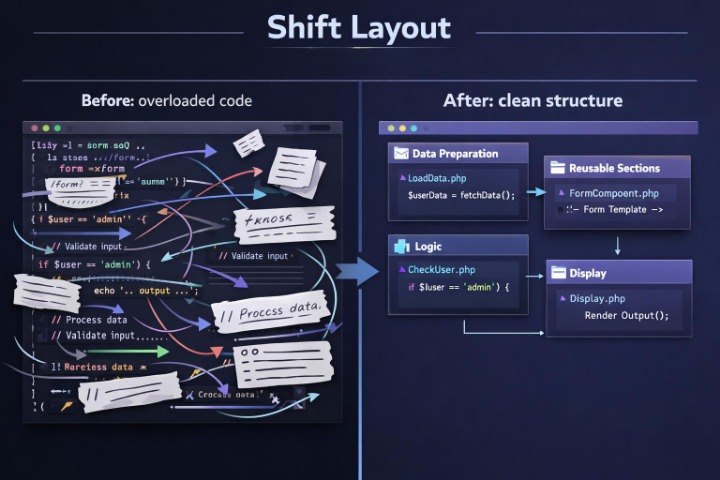
This course will teach you how to organize PHP programming examples through file structure, layout thinking, reusable sections, and clear code placement. Shift Layout explains how to move from one large fragment to a more organized build. The learner reviews how to separate repeated parts, how to keep data preparation apart from display, and how to think in blocks. The materials are built around practical learning scenarios where structure matters as much as syntax. This format helps learners read, change, and extend examples more calmly, without unnecessary complication.
3. What’s Inside
- Module 1: Layout Thinking in PHP — the learner explores the idea of code composition: what belongs to data preparation, what belongs to check logic, and what belongs to display. The module helps learners view an example not as one long file, but as a set of parts with their own roles.
- Module 2: File Structure Basics — a breakdown of basic PHP file organization in learning examples. The learner sees how to place code fragments so they are easier to read, repeat, and gradually adjust.
- Module 3: Separating Logic and Display — an explanation of how to avoid mixing checks, data handling, and display in one crowded block. The module shows how to prepare values before they enter the page section.
- Module 4: Reusable Page Sections — work with repeated sections that can be used in several learning scenarios. The learner reviews headings, lists, messages, cards, and other blocks with similar logic.
- Module 5: Includes and Small Parts — an introduction to an approach where a page is built from smaller parts. The module explains how to think in these parts, when it is useful, and how to avoid creating extra confusion.
- Module 6: Data Before Layout — practical work with preparing data before display. The learner sees how arrays, conditions, and functions can work before information moves into a structural block.
- Module 7: Layout Review Patterns — a set of learning patterns for review: an item list, a data card, a message after a check, a simple page with several sections, and a repeated block.
- Module 8: Shift Practice Board — a practical section with tasks where the learner takes an unstructured example and gradually divides it into clear parts. The tasks help practice careful reading, moving logic, and organizing code.
4. Who Is This For?
✅ A good fit if you:
- already know basic PHP programming topics;
- want to organize learning examples more clearly;
- want to understand how to separate logic and display;
- have worked with forms, conditions, arrays, and data output;
- want to learn how to think of a page as a set of parts;
- are ready to complete practical exercises in code organization.
❌ Not a fit if you:
- do not yet know basic PHP syntax;
- are looking only for a short introduction without detailed review;
- do not plan to work with file structure;
- do not want to analyze examples and move code parts;
- are expecting claims about jobs, clients, or financial results;
- want learning without independent practice.
5. What You’ll Learn
- Understand basic PHP code composition.
- Tell the difference between data preparation and display.
- Organize learning examples into clear parts.
- Work with basic file structure.
- Separate repeated page sections.
- Use small parts for better order.
- Prepare data before placing it into a structural block.
- Understand where arrays, conditions, and functions are useful.
- Read examples made of several sections.
- Move logic from a scattered fragment into an organized structure.
- Analyze a page as a set of connected blocks.
- Complete practical tasks in code organization.
6. 30-Day Return Review
The Shift Layout plan may include a 30-day return request review period according to Syntaxor store rules. The terms depend on the material format, course usage status, and current service policy. Before placing an order, we recommend carefully reviewing the purchase terms page and material usage rules. If questions appear about the course structure, difficulty level, or learning materials, the Syntaxor team can provide explanations through the contact form.
Who are Syntaxor courses created for?
Who are Syntaxor courses created for?
Syntaxor courses are created for people who want to study PHP programming through structured materials, examples, and practical tasks. They are suitable for independent study, review of basic topics, and gradual work with server-side logic. Each plan has its own material scope, so learners can choose a format that matches their current level.
What is included in Syntaxor plans?
What is included in Syntaxor plans?
The plans may include lessons, text materials, code examples, practice tasks, diagrams, checklists, and independent exercises. The exact content depends on the selected plan. All materials are built around PHP programming, code logic, file structure, data handling, and practical thinking.
Share