Syntaxor
Spark Sphere
Spark Sphere
Couldn't load pickup availability
Self-paced learning overview
- 📁 Downloadable digital materials
- 📚 Study offline after download
- 🔒 Secure checkout
- 🗓️ Content updated in 2026
1. Problem Statement
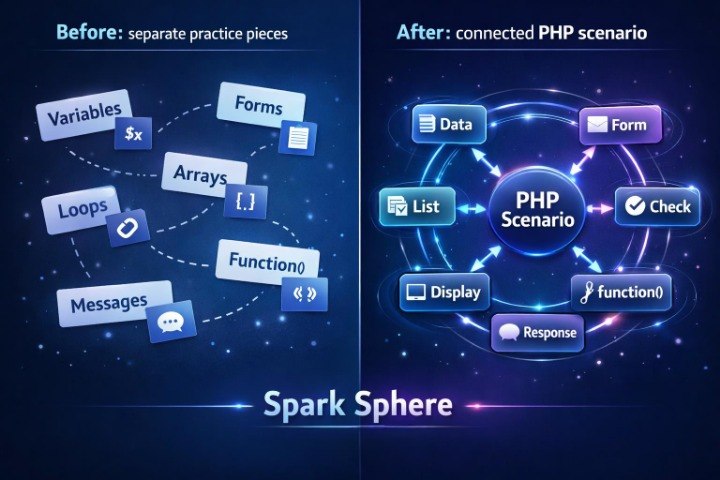
Struggling to connect different PHP programming topics into one working learning scenario? You’re not alone, because after studying variables, conditions, loops, arrays, forms, and file structure, a new challenge often appears: how to combine all of it without disorder. Separate topics may feel familiar, but when several parts need to be gathered into one learning example, questions appear about order, logic, and code placement. A learner may understand how a form or loop works, yet not always see how they interact with data preparation, checks, and display. Spark Sphere is created to help learners move toward more organized practical thinking.
2. Solution
This course will teach you how to build connected PHP programming scenarios through organized modules, practical examples, and structured exercises. Spark Sphere explains how several topics can work together within one learning task. The learner reviews scenarios where data is created, checked, passed, handled, and displayed through clear blocks. The materials are not focused on only one syntax rule; they show connections between code parts. This format helps develop skills in reading, analyzing, and building larger examples without exaggerated claims.
3. What’s Inside
- Module 1: Scenario-Based PHP Thinking — the learner explores an approach where code is viewed as a sequence of actions: data preparation, checking, handling, response, and display. The module helps learners see not only separate lines, but the full logic of a learning scenario.
- Module 2: Data Preparation Layer — a breakdown of how to prepare values before using them in a form, list, message, or structural block. The learner works with simple variables, arrays, and conditions that help make an example clearer.
- Module 3: Form and Response Flow — a practical explanation of how a form passes data, how it is read in code, and how a response is formed. The module focuses on the connection between input, checking, and later display.
- Module 4: Lists, Cards, and Repeated Blocks — work with repeated elements created from arrays and loops. The learner studies how to form lists, cards, or data blocks without unnecessary logic duplication.
- Module 5: Helper Functions in Practice — creating small functions for preparing text, checking values, or reusing logic parts. The module explains how functions can make a larger example easier to read.
- Module 6: Organizing a Learning Example — the learner reviews how to divide a practical example into several clear parts: data, checks, logic, messages, and display. The module helps avoid mixing everything into one long fragment.
- Module 7: Small PHP Study Scenarios — a set of scenarios for independent work: a simple item list, a form with a response, a data card, a conditional message, and a block with repeated values.
- Module 8: Sphere Practice Set — a practical section where the learner combines materials from previous modules into several learning examples. The tasks help review structure, logic, data, forms, and display in one route.
4. Who Is This For?
✅ A good fit if you:
- already know basic PHP programming topics;
- want to connect several topics in one learning example;
- have worked with variables, conditions, loops, arrays, and forms;
- want to better understand the order of building a practical scenario;
- are looking for a course focused on structure, logic, and review;
- are ready to work independently with exercises and analyze code.
❌ Not a fit if you:
- do not yet understand basic PHP syntax;
- are looking only for a short introduction to the topic;
- do not want to work with practical scenarios;
- expect complex system topics without reviewing the basics;
- are looking for claims about jobs, clients, or financial results;
- do not plan to complete independent tasks.
5. What You’ll Learn
- Connect several PHP programming topics in one scenario.
- Understand the sequence: data, check, handling, response, display.
- Prepare values before using them in examples.
- Work with forms and simple responses.
- Use conditions to control scenario behavior.
- Create repeated blocks through arrays and loops.
- Write small functions for data preparation.
- Divide an example into logical parts.
- Read code where several topics work together.
- Organize larger learning fragments.
- Complete practical scenarios with forms, lists, and messages.
- Develop a careful approach to building PHP examples.
6. 30-Day Return Review
The Spark Sphere plan may include a 30-day return request review period according to Syntaxor store rules. The terms depend on the material format, course usage status, and current service policy. Before placing an order, we recommend carefully reviewing the purchase terms page and material usage rules. If questions appear about topics, format, or difficulty level, the Syntaxor team can provide explanations through the contact form.
Who are Syntaxor courses created for?
Who are Syntaxor courses created for?
Syntaxor courses are created for people who want to study PHP programming through structured materials, examples, and practical tasks. They are suitable for independent study, review of basic topics, and gradual work with server-side logic. Each plan has its own material scope, so learners can choose a format that matches their current level.
What is included in Syntaxor plans?
What is included in Syntaxor plans?
The plans may include lessons, text materials, code examples, practice tasks, diagrams, checklists, and independent exercises. The exact content depends on the selected plan. All materials are built around PHP programming, code logic, file structure, data handling, and practical thinking.
Share